The Black Army of Wudor was a widespread pseudo-religious peasant revolt originating in Margard that was an active combatant in the Second Ettish War from 1329 to 1351.
It was a direct successor of the Free Republic of Margard.
 Standard of the Black Army of Wudor.
The text translates to “Our ears hear no voice but The Myriad.”
Standard of the Black Army of Wudor.
The text translates to “Our ears hear no voice but The Myriad.”
Background
Having suffered from a complete lack of internal stability for years in the immediate aftermath of the Onyx King’s War, the Kingdom of Valens demanded increasingly large sums of grain, manpower, and wealth in order to fuel it’s additional conquests. As one of the least developed parts of Central Wudor, ethnic Ettish People areas were hit especially hard by these demands, and often had their local governments sidelined if they could not provide adequate resources to the Valenic crown. Likewise, Ettish nobles planning imminent revolt against the Valene crown imposed greater demands on their peasantry while utilizing the proceeds to stockpile grain and weaponry for the coming conflict.
As a result, peasants in and around the Valenic-Ettish border were deeply hostile towards both local Ettish nobility and Valenic soldiery, tax collectors, and representatives of the Valenic crown sent to replace local Ettish rulers after they repeatedly failed to deliver sufficient results. Attempts to evict these groups from their lands began as early as a year into the Onyx King’s conquests, though they would be swiftly and brutally vanquished by the armies of local Valenic nobility, and often, Ettish middlemen, or Valkoons, utilizing personal levies and mercenaries to retain their titles. Such hostilities are a large part of why the Black Army would remain hostile to the Republic of Ettmark once Ettish gentry revolted against the Valenic crown.
While plans to decisively deal with the peasant issue through increased oversight of the activity of local nobility were being drafted, the Valenic Queen-Regency in the immediate aftermath of the death of the Onyx King Archebaud de Fleur was far more concerned with both revolting Ettish gentry and an opportunistic invasion of Valenic Carettia by the Evershining Empire in what would be known as the Carettic War. This neglect of the peasantry eventually saw several sporadic peasant uprisings in and around Margard, which would end up ejecting the Valenic garrison.
Second Ettish War
The revolt of Ettish peasantry in Margard was viewed as a victory by the Ettish Raat, which immediately dispatched diplomats to Margard to facilitate it’s integration into the Republic. However, the diplomats were executed, and it was made clear that the peasants had no interest in living under the corruption of coin any more than they did oppressive nobility. Following this, both Valens and Ettmark remained in an open state of hostility with the Black Army, and a short stall in hostilities between the two combatants began as a priority was placed on limiting the spread of peasant activity in the region. However, raiders hired by the Ettish would repeatedly violate this statute, leading to the near-immediate resumption of mutual hostilities.
The composition of Black Army forces was deeply unstandardized and drew mainly from anyone who had a grievance of sorts with either Valens or Ettmark- while the majority of Black Army forces derived from peasants or townsmen, those with other outstanding hatreds towards either side of the Second Ettish War joined their ranks.
Among these were Myriadic devotees who believed that certain laws, including various incursions of Valenic and Ettish highborne on the common land of their respective peasantry, constituted a violation of good governance. Despite the participation of a large number of Myriadic faithful in the Black Army’s campaigns, they remained overtly hostile to the religious institutions of Ettmark and Valens alike, believing them corrupted and subverted by the state, or otherwise guilty of wanton abuses.
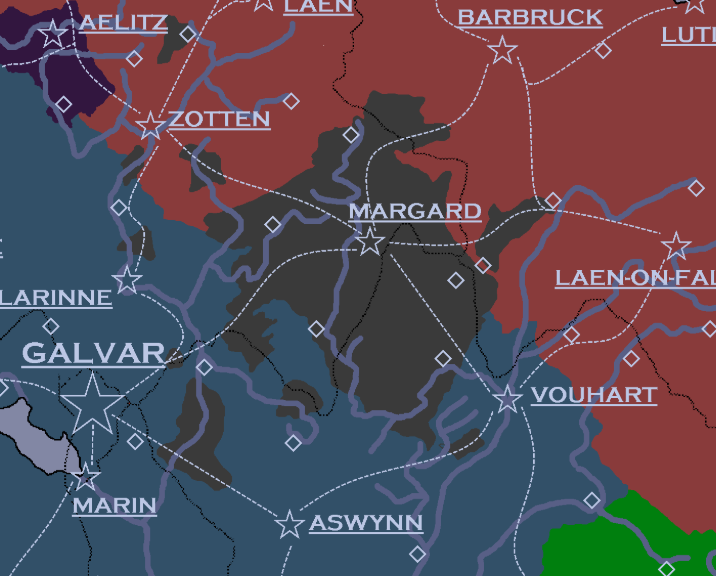
The maximum extent of control by the Black Army of Wudor.