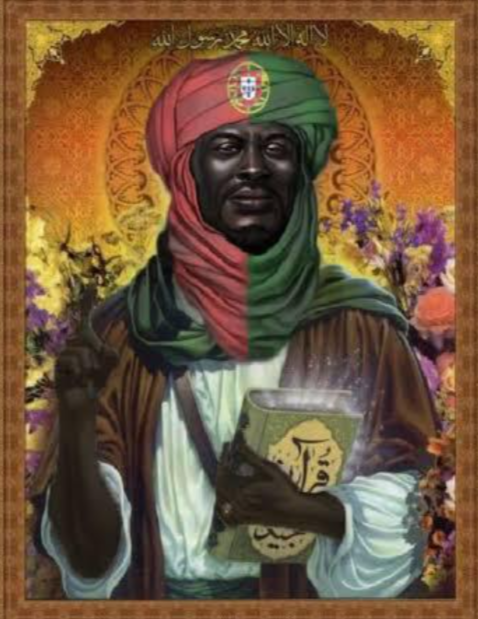
An Aksadani depiction of Yakoub.
Little is known about Yakoub, allegedly the only surviving God of Daoudharam’s pantheon after a staggering divine war estimated around nine years after the death of Voadn that rocked the majority of what is now Qasmatus. According to the region’s chronicles, the destruction of the Shining Empire led to widespread shortages, while a naval landing of the Heartrender Clan of the Orcish Horde pillaged the eastern coast and drove displaced harpies into the core arable coastal regions of northern Daoudharam. Within these twenty-nine years, over one-third of the entire population of Daoudharam was estimated to have been killed. Izîl Koumadhan was the first to step in, proclaiming that the Myriad were false deities and that the ancient Yakoub of the Daoudharami pantheon, formerly a local deity, had announced to him that the mistakes of others had now led to a war in which the righteous must band together and fight once more. Koumadhan rallied the desperate forces of the region, quickly legalized the previously-banned accretion of Khalq, signed a concordat with the Harpies, and moved to engage Gulra II Heartrender on the eastern coast. With over half the continent occupied by the Orcish Horde, Koumadhan was seen to have died in an explosion that took out both him and most of the Orcish army, and left a massive glass crater in the middle of the desert that remains an impassable barrier to this day. Historians at the time interpreted this as Yakoub himself, the last surviving member of the Daoudharami pantheon, having sacrificed his own life to grant the Daoudharami people freedom from slavery and the ability to choose their own path._ -
As such, Yakoub is worshipped in absentia in a henotheistic manner, in which he is not believed to have domain over all the world, only his home continent. They view the Myriad in this same light and fiercely resist attempts at re-conversion, believing that the old Daoudharamis betrayed the God who gave his life for them long ago when they first committed to worship of the Seven. The worshippers of Yakoub can be clearly divided into_ Wish Cultists and Horizon Cultists. _Both Cults recognize that the death of Yakoub was a voluntary act made to prevent the influence of the heavens and the influence of the mundane from being forever severed from each other, as He knew that the era of Divine influence over Daoudharam was ending, but wished for his people to be able to continue doing what he did. This is achieved via the performance of Khalqam, actions that appease the lasting metaphysical force of the combined consciousness of these Gods, allowing for numerous boons and omens and for the Divine to voice their approval or disapproval of a situation from beyond the heavens and their now-departed divine vessels. Horizon Cultists believe that the absorption of sufficient Khalq will one day give rise to a new deity manifest, and often performing as many righteous acts as possible and living as righteously as can be towards this end. Wish Cultists view this as a perversion of the Khalq, and believe that the accumulation of Khalq in pursuit of power is an inversion of the intent of it’s existence. Regardless, such a statue typically leads Horizon Cultists to be more proactive in the elimination of evil, and purportive of social and geopolitical change they consider ‘just.’ While Wish Cultists view the maintenance of the peace as an innate boon in of itself and generally favor peace over conflict, Horizon Cultists deny this outright and encourage the notion that injustice and evil should be challenged with conflict, even if there are casualties in between.
Due to the henotheistic nature of the faith, worshippers of Yakoub generally lack a vendetta against Myriadics unless proslytezation attempts are made, and believe the past conversions to be the fault of the First Shining Empire rather than the Myriad itself. However, it is still uncommon for a practicioner of Khalq or worship of Yakoub to freely voice their professed faith in Carettia, and Yakoub is recognized as at best a benevolent spirit by Myriadic theologians._